Monday, December 22, 2014

The Good, the Bad, and the Neurotypical

"Ignorance is bliss" wow I have never felt a adage more than I feel this one.
That which is not known is not worried about
What you don't know won't kill you
If you can't see it, it's not a problem.


All of these, they mean the same thing and this thing is probably one of the most important concepts to understand and learn in adolescence. We all had those moments in kids where we heard something that scared the shit out of us and we worried about it for days, weeks, in my case it was months.

When I was in second grade my older sister told me about Global Warming and how we're all going to die because of it, and my life took a downward spiral as a child. I couldn't sleep for probably 2 months after she told me that, just worrying. The majority of my thoughts were devoted to "Holy shit I'm going to die" and with this I had the first existential crisis of my life. I worried about death and the fact that I wasn't always going to be alive and my loved ones weren't always going to be alive either. It's a lot for an 8 year old to take on her shoulders, but I'm kinda glad that it happened early to me.

I by no means came to terms with death after that event (that wouldn't come until about a year ago, to be honest) but it really opened my eyes and ruined my mind.

I honestly believe that those defining and eye-opening moments when I was around 8 or 9 were the start of the slippery slope from the neurotically to the mentally unhealthy.

If you've ever taken a depression self-test you'll know that several of the questions deal with existential topics such as "Do you feel your life is worthless?" or "Do you believe life is meaningless?"

These questions, usually phrased a bit less accusatory and moody, are some of the focal points of existential crisis. If asking questions like that are a part of diagnosing depression and other mental illnesses, there must be a correlation from existential thought to mental disorders.

In fact, some of the most inspirational and oddly existential people in the world suffered from depression and fell victim to it as well.

David Foster Wallace who wrote "This is Water" committed suicide after suffering from depression for years only a few years after he delivered this speech.
Robin Williams, one of the most famous suffers and victims of depression, played several amazing and inspirational roles. (Dead Poet's Society changed my life)
Ernest Hemingway, famous and enlightening American author also took his own life.

So what does all of this mean? Is it just a part of the disease of depression to result in existential thought, or do the thoughts themselves lead the person to depression? Which came first, the chicken or the egg.

And how much knowing really hurt us in the end? Is it sometimes better to not know at all?

Perhaps it's better not to find out....

"But I was blessed with bad eyes
                        There's a lot that I miss but I don't mind, I'm not that old
                                   I'll find out what broke me soon enough"
-Radical Face: Glory

How to Ruin your Life in 3 Easy Steps


If you've ever played mario kart with me, you're probably not my friend anymore.
More times than not I ramble the excuse, "My parents never put me in competitive sports so I never learned how to take a defeat." But in reality, I am just a horribly, over competitive person.
From having the best animal crossing town to always getting the highest grades (and not-so subtlety bragging about all of these things), I have to have the best and be the best.
So whenever I play
Mariokart
Super Smash Bros


I get overly competitive, loud, and super duper angry. 

But why? Why am I so competitive and loud and angry when I get passionate about stuff?

1) Natural Selection
So yeah, let's just blame everything on genetics and evolution, but really it's pretty relevant right now! It isn't called survival of the fittest for nothing, only the fittest survive in the competition for resources. Yes, competition, it is ingrained into our souls. So there's no wonder that we're competitive people! It may not be life or death, but we gotta compete and we gotta want to win! 

2) Social Norms
Okay what fun would mario kart be if everyone just sat there and kinda just played? Forming social bonds is formed by trust, and more times than not, mutual enjoyment of an activity. If you're gonna be friends with someone you want to enjoy what they enjoy too. If someone's having a blast (although getting mad a bit too) while getting stars left and right in mario party, you're gonna want to have fun and be engaged, or at least seem like you are having fun, too if you want to befriend this person! Monkey see monkey has to do if they want bros.

3) BRO ITS JUST HARD NOT TO BE COMPETITIVE
If you like something, you're going to want to  be good at it. If feels good to win, and we crave that naturally. To be the best means to live, and to rub it in the faces of your friends. Even the most even tempered person has their field they just have to be the best, even if subconsciously. Don't be afraid to let this side out! It's hecka fun and gets the blood pumping.
Just remember, don't get too mad when you lose. 


Monday, December 15, 2014

Blood is Thicker than Water?

Blood is Thicker than Water, what the hell does that even mean?
Yeah, of course blood is thicker than water, you numbutt asswad, that's basic science stuff and I know that.
But what does that even MEAN for real?

To be honest, I love the saying, but not the well known one, the lesser known actual version of this common adage.

"The Blood of the covenant is thicker than the Water of the womb"

Yeah, now we're making some sense.
So what this is telling me that a bond of a promise is stronger than the bond between kin, yeah yeah I can see that.

But is is really true? I mean, I love my family and all but dayum, would I really value my "blood" brother over my BLOOD brother?

I guess it really depends on the relationship you have with your family. Some people really love their family, but other people don't really all that much.

I mean, look at popular literature for some perfect examples of this stuff. Think of Hunger Games, think of Divergent, (think of all those FANTASTICALLY AWFUL trash fanfictions you spent this weekend reading) think of almost any sort of pressure-inducing scenario where we are stripped to our raw desires and thoughts, we must decide not out of practicality but out of what our whims tell us in these times.

In some cases, it's always family first, in other cases it's the promise you made.

This thought in and of itself is a moral dilema, or as I like to call them "One way trip to argument and uncomfortable conversations that are oddly fun."

Gun to my head, I would choose my family over a promise made in a heartbeat.
But what if the promise is to my family? What if it's to another loved one who I may not be related to by blood? Is anything sure in this world?

Will I continue to scream into the empty void as I realize that I need to freaking study better because I am making to progress in my life?

What did I just type that, whoops that's embarrassing.

I can only hope that I will never come across a situation where I need to choose between a promise or family, but I know that if I do I would make the right choice.

Tuesday, December 9, 2014

Kill Fuck Marry

It's times like these that make me think about what the great American Author, Lebron James, always says.

"A path diverged in the yellow woods, and I chose to fuck it."
-Albert Einstein


I have the social habits of a 6th grader, my favorite pastimes with friends includes making really really bad dick jokes, talking trash about other people, and playing kill fuck marry; the epitome of immature games. Kill Fuck Marry possesses the perfect cocktail of making your friends uncomfortable and being able to make some really great jokes.

Let me just toss out some ideas to get the ball rolling.

Pillsbury Dough Boy, Mrs. Buttersworth, Mr.Clean
(aka- What's in my Pantry?)
your past self, your current self, your future self
(aka- I'd fuck me)

Good Morning America Anchor George Stephanopoulos, Fox News Anchor Gregg Jarrett, CNN student news anchor Carl Azuz
(aka- big news)

Yet as funny as my inhibitions and desires are, wow am I pretty lofty with them. I know that I'll never be able to fuck Zac Effron, marry the foam shark used in filming the original Jaws, or kill the egg farmer from Napoleon Dynamite; and no amount of wiki-instructed ambition is going to change this fact. 

Yet we still have these unreachable dreams. Why?

If we look at the dearest Freudian Stages of Development  and the theories it suggests, all adulthood issues tie into how our childhood was. What if our childhood guides how goal-orientated, lofty or not, we are in the future. If it's gonna happen that way, it's gonna be in the latent period. In this time we develop our self-esteem and other super-ego based concepts are gonna be developing, and this goes aallllll the way down into our deep, dank, dark, dirty subconscious. 

So say sweet dear little Rose was told in this phase that "You can't be the president you're a girl" or told "You can totally be the president!" How is Rose going to look at the life ahead of her?

What about you, what were you told in your Latent phase? Did your parents support all you did and your ambitions, or did they yuck your yum? 

Wether or not you're willing to work for these dreams is another topic entirely, but I ask you, dear reader, is there anything wrong with being too ambitious? There's always the let down of when you realize these things might be unrealistic, but I think that the hope and the faith that these dreams instill in you each and ever day far outweighs the weight of disappointment. To have hope alone is a powerful thing.

“He who robs us of our dreams robs us of our life.” 
― Virginia Woolf, Orlando


Wednesday, December 3, 2014

Morbid Beauty

Oh three-dimensional printing, how you are changing the world of technology and laws. 
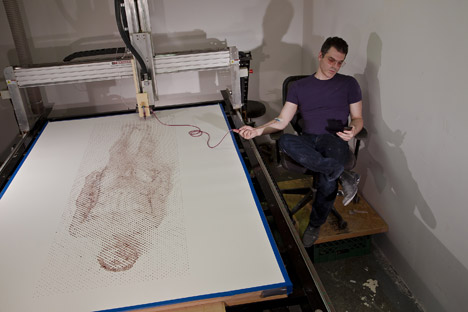
Yet with all of your innovations I can't help but look at something like modifying a printer to make a self-portrait with blood replacing ink and have true second thoughts.

"Sick, dude"

Yet despite being slightly off put by this, almost appalled, I can't help but think how seriously cool it is too. How very punk rock of Ted Lawson to do this. It's one thing to paint a self portrait, but it's super fucking metal to do it with your own blood. Rock on, Ted Lawson.

Yet I can't help but feel uncomfortable with how much of his own life he's giving up to make this. It goes against the law of nature, yet that's almost what makes it so interesting. We live to preserve and expand our lives, and to freely give up what keeps you alive like this, it's very odd. It creates a contrast in the necessity of necessities themselves in today's modern life. (I find the same contrast in a different manner through those really cool gardens that uses skulls as planters. Death is my aesthetic, bruh.)  We live now not only to create and breath, but now we live to experience and transcend. 

Wow this sounds like something else that I like to reference a lot, MASLOW'S HIERARCHY OF NEEDS, BRO.


"Aka: Eat, Sleep, Transcend, repeat."

I could go on and on about how much this stuff ties in perfectly with advanced society,  but just look at it for yourself. Open your slimy eyeballs and rub them directly onto the computer screen. Yes, just like that. Perfect.

So it's very obvious that instinctually we value life as a more secure and sacred thing that death as it is our first instinctual thought; the base of our pyramid. But what happens when these things become a given? My theory is that we begin to value other concepts with equal prowess as we give to life. Take for example the modern love tale. People tend to value love a lot these days, and boy does it show in our media and expectations of, well everything.

So what happens when all of the needs are met up to the point of self-actualization? Will nirvana replace the modern love story? Will we have a need for all of these things at all? With true transcendence (depending on who you ask) comes a loss of the fear of death and acceptance of what it holds. This concept, although scary, could potentially be held in high esteem if we keep advancing and setting the bar higher for what needs are fulfilled on Maslow's Hierarchy. Maybe one day, death will be just as beautiful as life.


Thursday, November 27, 2014

Puer Aeternus

I had another epiphany today. It was a simple and humble epiphany in which I finally figured out how to curl my hair. Most epiphanies I have are very provocative and motivating but usually end up taking me no where. Like revving up your car only to run into another brick wall and all of a sudden you need to get another shitty car to run into another wall. By now I'm very sure no insurance company is gonna give me coverage. But I don't need it.

The more I think about it the less I feel I need others to cover me when I'm down or to lift me up when I'm happy. I've drawn most of my energies from self-contemplation and meditation, which don't really involve others. Don't get me wrong, I'm no loner, I love spending time with others, but when it comes to spiritual fulfillment I feel the self is best.

Yet despite all of these ideas and revelations that I can find happiness in my own solitude, I feel as if my tires are still spinning and I'm getting no where. I don't work hard like I should. I suffer from Puer Aeternus.

My 2 years of Latin have taught me a few things, and I can tell you Puer Aeternus means eternal boy. Think of Peter Pan, think of Tuck Everlasting, think of yourself.

"As soon as I get out of high school, my life will start"

"I can't wait to get into the real world"

"Someday everything will fall into place"

If you're thinking these, you're thinking puer aeternus. The concept that life won't really begin, it hasn't really begun, is so dangerous. As high schoolers there might not be any greater plague than this because it creates a disconnect between our life and our dreams. Instead of "My good grades will get me into college" we should be thinking, "My life experiences are important". It's not about what we do today to make tomorrow better, it's about what we do now to make today better.

If everything we do and everything we think is a great fantasy of when we will become what we're meant to, we'll never become what we're meant to. We'll be stuck on Neverland our entire lives.

How can we escape?

Well, it depends. I plan to start doing more things for the now. Things that will not only help my future plans, but also improve myself today. I need to become the best I can and it can't wait until the day I graduate, the day I get a job, the day I get married. Today is the day I am the best I can be.

"Today we're younger than we ever gonna be"

"Oh Captain, my Captain"

“A disciplined mind leads to happiness, and an undisciplined mind leads to suffering.” 

Monday, November 3, 2014

An Analysis of the Flash Experience "I Think I'll Be Okay"

I Think I'll be Okay is a flash experience (I would use game but it's really not a game at all) that follows the author's expressions and emotions while dealing with depression, isolation, and a toxic familial setting. It plays in a similar fashion to a choose your own adventure type book and has more reader input than a simple novel or short story, yet it still follows a progression that cannot be changed.

The author uses beautiful imagery and diction to create a somber and deeply provoking setting. I would not suggest playing this if you are going through some depression or even an existential crisis at the moment as, coming from experience, these kinds of things can really be quite the trigger into worsening things, so precede with caution.

However, if you find yourself to be a pretty emotionally stable person, it's not really gonna have it's full effect on you. The nature of this type of narrative is most effective in portraying emotion to those who have some sort of depressive history, as this will allow the reader to better understand and relate to the situation.

All warnings aside, the rest of this post will contain spoilers, so I would suggest playing the story before continuing.


Coming from a very empathetic person, this story was very very touching for me. It really displays how a situation is all that you  make it. The narrator is trapped in a hostile situation and feels constantly isolated, and the blur of time yet mild comprehension of a timeline is a fantastic measure of creating the feeling of being stuck to the reader. Yet despite this, the narrator finds a happiness in their life through the jars of rain. Although overall the entire piece is a somber story, the final part is a tad more uplifting, and I even cried a little while reading it. This ending created a feeling a hope near the end, and is inspiring towards those who might be going through a similar situation. 

Although the story also partakes in the "my situation is tough but this person has it worse" guilt effect. Nothing feels worse than this guilt. Like, who the heck wants to think "Yeah I failed this test but this person fails every test". It brings up the topic of how belittling feelings is sometimes even worse than the feelings themselves. No one should ever have to be told "your feelings are irrelevant" as all we do as humans is seek relevance. The narrator in this story is struggling with this very same thing, relevance. They feel no companionship and it is isolating. There is no one to confirm that their feelings are justified, so they feel guilty for having them.

Within this lack of justification, we can see why it is so helpful for people who are going through personal struggles to get help from a third party. They can tell them that it's okay to feel this way and help them move on, while without this the person's emotions will only fester. This third party can be many many things. It can be a friend, a therapist, a family member, or a god. In my opinion, this is one of the only useful things about theology in modern society, personal comfort and security. This security is how people are so fervent in their faith, and it is totally understandable. It's uncomfortable to face difficult life questions, and sometimes faith lets us slide by with answers that aren't fully supported by anything other than "you just gotta believe". Yet if faith is what makes you happy, then that's alright.

The narrator in the story uses faith as a comfort as well, as they pray to the rain. "Pray to the rain?" The Abrahamic religions say, "That's paganism." Yes, yes it is, but is that so bad? Who's to say that the idea that everything is god versus god is everything is not the more modern theological idea.

However, this is a different discussion for a different day. 

Maybe..... next time?